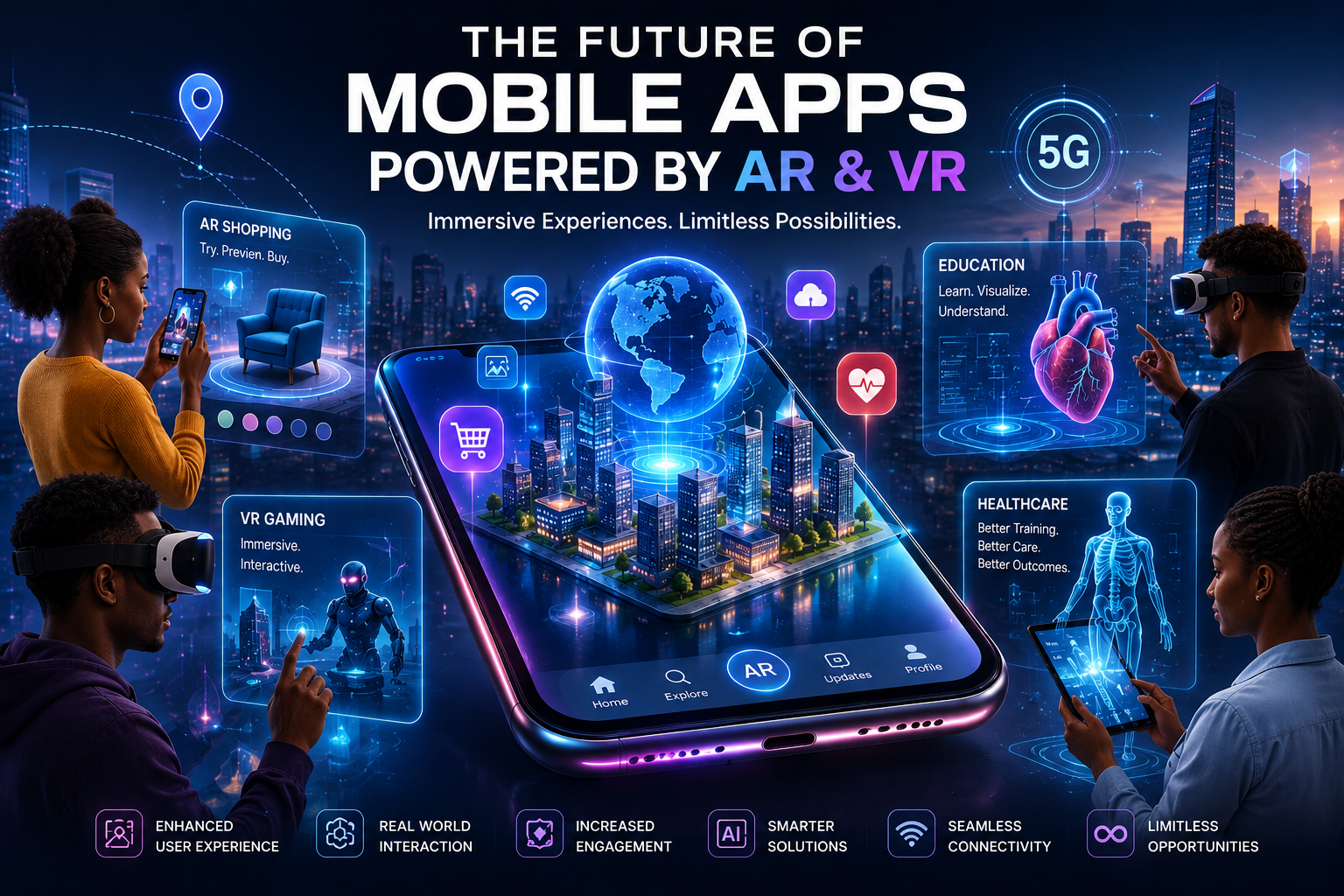

The mobile application industry is undergoing a remarkable transformation. What began as simple communication and utility tools has evolved into sophisticated digital platforms that power businesses, connect communities, facilitate commerce, and enhance everyday life. As technology continues to advance, user expectations are changing rapidly. Modern users no longer want applications that simply function well; they expect experiences that are immersive, interactive, personalized, and engaging.
Among the technologies driving this evolution, Augmented Reality (AR) and Virtual Reality (VR) stand out as some of the most transformative innovations shaping the future of mobile applications. Once considered futuristic concepts limited to gaming and science fiction, AR and VR are now becoming mainstream technologies that are redefining how people interact with digital content through their smartphones and mobile devices.
From retail and healthcare to education, real estate, tourism, and entertainment, AR and VR are unlocking new possibilities for businesses and developers alike. As mobile devices become more powerful and network technologies such as 5G continue to expand, the role of AR and VR in mobile app development will only become more significant.
This article explores how AR and VR are revolutionizing mobile applications, the benefits they offer businesses and users, and what the future holds for these immersive technologies.
Understanding Augmented Reality and Virtual Reality
Before examining their impact, it is important to understand what these technologies are and how they differ.
What is Augmented Reality (AR)?
Augmented Reality enhances the real world by overlaying digital information onto a user's physical environment through a smartphone, tablet, or wearable device.
Instead of replacing reality, AR adds interactive digital elements such as images, animations, text, and 3D models to what users see around them.
Common examples include:
- Virtual furniture placement apps
- Social media filters
- Interactive navigation systems
- Product visualization tools
- Educational AR applications
- Real-time translation overlays
AR allows users to experience digital content while remaining connected to their physical surroundings.
What is Virtual Reality (VR)?
Virtual Reality creates a completely immersive digital environment that users can explore and interact with.
Unlike AR, VR replaces the physical world with a simulated environment, often experienced through VR headsets or mobile-powered VR devices.
Examples include:
- Virtual gaming worlds
- Interactive training simulations
- Virtual property tours
- Virtual classrooms
- Immersive entertainment experiences
- Digital collaboration environments
VR creates a sense of presence that allows users to feel as though they are physically inside a digital space.
Why AR and VR Matter in Modern Mobile App Development
Mobile apps have become central to daily life. Businesses compete fiercely to capture user attention, increase engagement, and deliver memorable experiences.
Traditional app interfaces rely on screens, menus, and touch interactions. While effective, these methods have limitations.
AR and VR introduce a new dimension of interaction by making experiences more natural, engaging, and immersive.
Key benefits include:
- Increased user engagement
- Enhanced customer experiences
- Improved information retention
- Higher conversion rates
- Better product visualization
- Stronger emotional connections
- Increased user retention
As competition in the app market intensifies, immersive technologies provide businesses with powerful tools to differentiate themselves.
How AR is Transforming Mobile Applications
Revolutionizing E-Commerce and Online Shopping
One of the biggest challenges in online shopping is uncertainty.
Customers often hesitate because they cannot physically see, touch, or try products before purchasing.
AR solves this problem by enabling customers to visualize products in their own environment.
Virtual Try-On Experiences
Fashion, beauty, and eyewear brands increasingly use AR to allow customers to virtually try products.
Examples include:
- Trying on sunglasses
- Testing makeup shades
- Viewing clothing styles
- Previewing jewelry
This reduces purchase anxiety and increases customer confidence.
Furniture and Home Decor Visualization
Customers can place virtual furniture in their homes before buying.
They can:
- Check dimensions
- Test color combinations
- Evaluate layouts
- Visualize final results
This improves buying decisions and reduces product returns.
Product Demonstrations
AR allows users to interact with products digitally and understand features more effectively.
This creates a richer shopping experience that drives conversions.
The Impact of VR on Mobile Experiences
Creating Immersive Digital Environments
Virtual Reality enables users to move beyond passive browsing and become active participants in digital experiences.
Users can:
- Explore virtual worlds
- Attend virtual events
- Visit digital showrooms
- Participate in immersive training
This level of engagement significantly exceeds what traditional applications can offer.
AR and VR in Education
Education is one of the industries benefiting most from immersive technologies.
Traditional learning methods often struggle to maintain engagement and simplify complex concepts.
AR and VR transform learning into an interactive experience.
Enhanced Visualization
Students can:
- Explore the human body in 3D
- Walk through historical landmarks
- Examine scientific processes
- Interact with engineering models
Complex topics become easier to understand and remember.
Virtual Learning Environments
VR classrooms create immersive educational experiences that allow students to engage with content in entirely new ways.
This improves knowledge retention and learning outcomes.
AR and VR in Healthcare
Healthcare organizations are increasingly adopting immersive technologies to improve both patient care and professional training.
Medical Training and Simulation
VR enables healthcare professionals to practice procedures in safe virtual environments before performing them in real-life situations.
Benefits include:
- Reduced training risks
- Improved skill development
- Better preparedness
Patient Education
AR helps patients understand medical conditions through visual demonstrations.
This improves communication between healthcare providers and patients.
Mental Health Applications
VR is being used to support:
- Anxiety management
- Stress reduction
- Exposure therapy
- Meditation programs
The immersive nature of VR creates powerful therapeutic opportunities.
AR and VR in Real Estate
Real estate is another industry experiencing significant transformation.
Virtual Property Tours
Potential buyers can:
- Explore properties remotely
- View multiple locations quickly
- Examine layouts in detail
This saves time and improves decision-making.
Property Visualization
Developers can showcase unfinished projects using AR and VR models.
Buyers can see future developments before construction is complete.
This enhances marketing effectiveness and accelerates sales.
AR and VR in Tourism and Travel
The travel industry is increasingly using immersive experiences to attract customers.
Travelers can:
- Preview destinations
- Explore hotel rooms
- Experience attractions virtually
- Plan trips more effectively
By reducing uncertainty, AR and VR encourage travel bookings and improve customer confidence.
Improving User Experience Through Immersive Design
User experience remains one of the most important factors in mobile app success.
AR and VR create experiences that feel:
- More intuitive
- More engaging
- More memorable
- More interactive
Rather than simply viewing information, users actively participate in experiences.
This increased engagement often leads to:
- Higher retention rates
- Longer session durations
- Increased app usage
- Greater customer satisfaction
The Role of Artificial Intelligence in AR and VR Applications
The future of AR and VR will be closely tied to Artificial Intelligence.
AI enables:
- Personalized experiences
- Intelligent recommendations
- Advanced object recognition
- Real-time environment analysis
- Adaptive virtual environments
The combination of AI, AR, and VR will create smarter, more responsive mobile applications capable of understanding user preferences and behaviors.
How 5G Technology Will Accelerate AR and VR Adoption
One of the biggest barriers to immersive experiences has been connectivity limitations.
5G technology changes this by providing:
- Lower latency
- Faster speeds
- Improved reliability
- Better support for real-time rendering
As 5G adoption grows globally, AR and VR mobile applications will become more sophisticated and accessible.
Challenges Facing AR and VR Mobile Development
Despite their enormous potential, several challenges remain.
Development Complexity
Creating immersive experiences requires specialized expertise and resources.
Device Compatibility
Not all smartphones support advanced AR and VR features equally.
User Education
Some users are still unfamiliar with immersive technologies and may require onboarding.
Cost Considerations
Development costs can be higher than traditional mobile applications.
However, ongoing technological advancements continue to reduce these barriers.
Future Trends in AR and VR Mobile Applications
Several emerging trends will shape the future of immersive mobile experiences:
- AI-powered AR assistants
- Virtual commerce experiences
- Mixed Reality applications
- Advanced virtual collaboration tools
- Interactive educational platforms
- Immersive healthcare solutions
- Virtual tourism experiences
- Smart city navigation systems
Businesses that embrace these innovations early will gain significant competitive advantages.
Conclusion
The role of AR and VR in the future of mobile applications extends far beyond entertainment and gaming. These technologies are transforming how businesses engage customers, how students learn, how healthcare professionals train, and how consumers interact with products and services.
As smartphone capabilities continue to improve and technologies like AI and 5G mature, AR and VR will become increasingly integrated into everyday mobile experiences. The future of mobile applications will not simply be about providing information. It will be about creating immersive, interactive, and meaningful experiences that bridge the gap between the digital and physical worlds.
Businesses that invest in AR and VR today are not simply adopting new technology. They are preparing for the next generation of mobile experiences and positioning themselves at the forefront of digital innovation.